


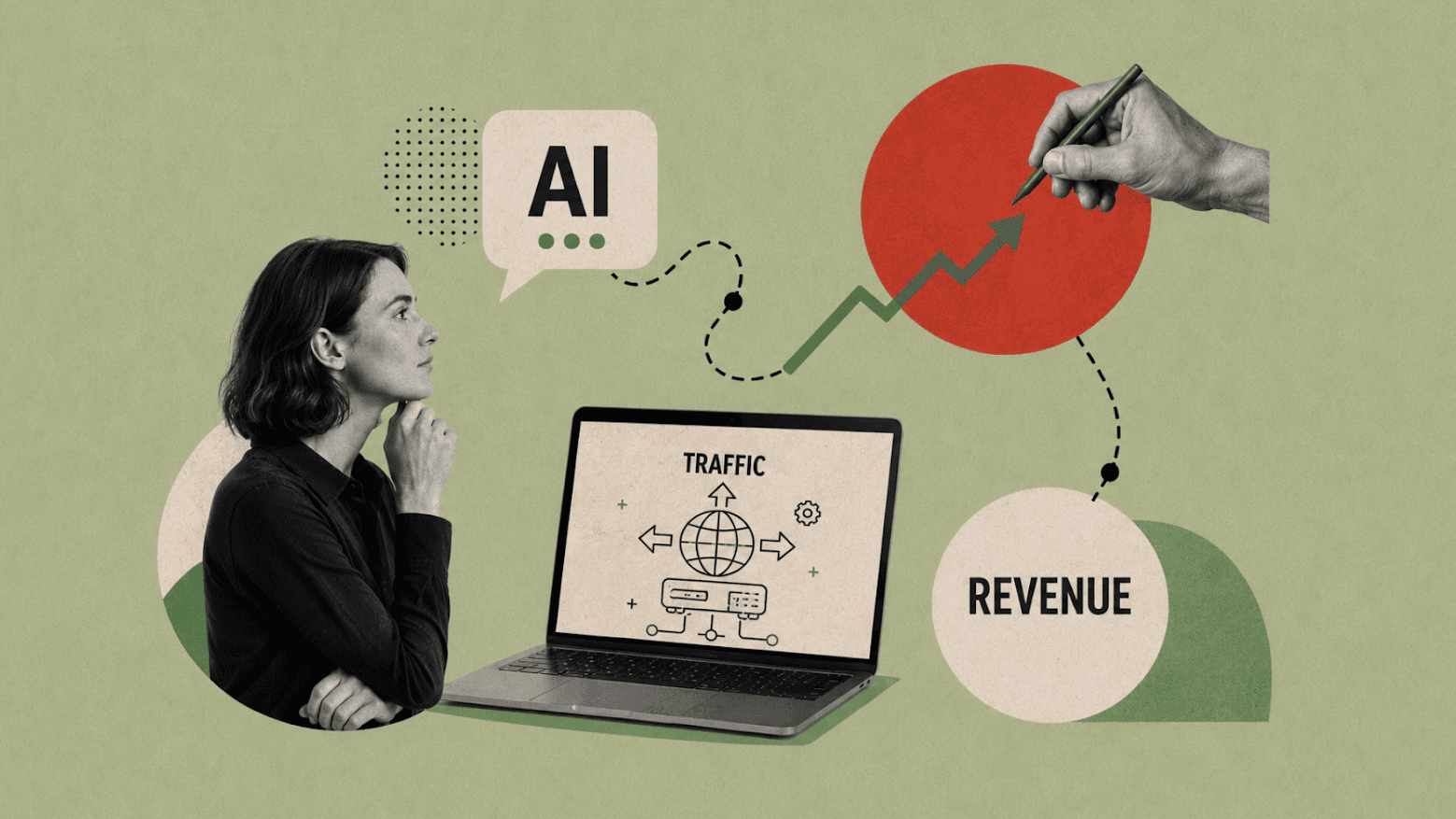
REVENUE WITHOUT TRAFFIC? RETHINKING MEASUREMENT MODELS IN THE AGE OF AI
by Chiara Naldi, Business Strategy Director
For years, traffic has been one of the main indicators used to interpret demand and assess the effectiveness of marketing activities. The assumption was relatively simple: the more people reach a brand’s touchpoints, the greater the opportunities to generate conversions and revenue.
Today, this relationship requires a more articulated interpretation. The spread of generative AI systems is changing the way people search for information, compare alternatives and make purchasing decisions. An increasing share of the interactions that influence demand develops before access to a company’s owned touchpoints and, in some cases, without such access occurring at all.
In this scenario, traffic continues to represent an important metric, but it loses part of its ability to independently explain the performance of revenue and the evolution of demand.
From Traffic to Demand: A Change in Interpretation Models
For more than twenty years, digital marketing has built a large part of its measurement models around what was observable: impressions, clicks, visits and conversions.
The growing spread of generative AI systems is putting pressure on this relationship. The change involves the channels through which people search for information and the environments in which evaluations, comparisons and preferences are formed.
Organizations therefore face a significant challenge: distinguishing between what is easily measurable and what actually generates value.
An Increasingly Distributed Customer Journey
Users ask for recommendations, compare products, explore features and build preferences before even reaching a website or an owned touchpoint.
An increasing part of the customer journey therefore develops in environments that exert a significant influence on decisions, leaving a smaller amount of signals compared to traditional digital journeys.
The Limits of a Traffic-Based Reading
Traffic remains a fundamental metric, but it represents an increasingly limited portion of the set of factors that contribute to the formation of demand.
Relying predominantly on this indicator to interpret market interest therefore risks providing a partial representation of the phenomena currently taking place.
Pressure on Attribution Models
This evolution also directly impacts measurement systems. When discovery, evaluation and part of the comparison process take place within conversational systems, the relationship between exposure and conversion becomes more difficult to observe.
Organizations therefore find themselves using interpretative frameworks developed to describe a customer journey different from the one that is emerging.
From Measuring Interactions to the Quality of Demand
The central issue concerns the quality of demand that marketing activities are able to generate, intercept and transform into value.
In a context where part of the decision-making journey becomes less visible, measuring only the quantity of traffic risks placing on the same level visits with very different degrees of intent, awareness and probability of conversion.
The evaluation of performance therefore requires greater attention to the relationship between quantitative signals, quality of interactions and economic results.
From Monitoring Channels to Understanding Demand
It is becoming increasingly important to complement the analysis of individual channel performance with a broader understanding of decision-making processes, the quality of generated demand and the contribution that each touchpoint makes to the creation of value for the business.
The ability to connect data, behaviors, context and economic results represents one of the elements that will distinguish the most effective organizations in the coming years.
A New Competitive Advantage for Marketing
Artificial intelligence is changing the way people build knowledge, evaluate alternatives and make purchasing decisions, introducing new levels of intermediation along the customer journey.
An increasing share of demand is formed in spaces that traditional measurement models struggle to capture.
In an ecosystem increasingly mediated by AI, the ability to observe, interpret and measure this space will represent one of the main competitive advantages for organizations and a strategic lever for connecting marketing to business results.